Leaving Inside: On Compassionate Detachment
October 18, 2026
Most adult children of emotionally immature parents only see two choices. They can keep showing up and getting increasingly emotionally drained, or they can cut contact and try to manage the guilt from it. Dr. Lindsay Gibson sees a third option: you can remain present on a controlled basis, and save your heart for the people who are able to receive it.
She calls it compassionate detachment, and she explained it in a recent Q&A on our channel.
Dr. Lindsay Gibson discusses compassionate detachment starting at 2:30
Why do you feel so drained after a phone call?
The first choice usually looks something like this. The call comes on a Sunday afternoon, the way it usually does. Your mother is upset about your brother, then about her neighbor, then about the fact that nobody calls her anymore. Within four minutes you've stopped what you were doing and gone to work. You're offering reassurance, reinterpreting the neighbor's comment, promising to visit sooner, softening your tone until it settles her. By the time you hang up, she sounds better, but you feel exhausted.
You collapse on the couch and doomscroll for an hour.
Most of us learned this job as young children. Your parent's distress was constant, and someone had to manage it. As adults we're already bracing as we pick up the phone and spend our time trying to placate the person on the other side of it so that things don't spiral.
You can care without taking it all on
Dr. Gibson describes compassionate detachment as staying in the relationship while detaching emotionally on the inside. You keep the contact and some of the compassion, but you stop absorbing your parent's distress as if it were yours to resolve. As she puts it, "you may not leave, instead you may just sort of leave inside."
For many adult children, that's the kind of permission they never realized they had.
Of course you want to help
The pull to rescue is strong for a reason. Dr. Gibson points out that chronic emotional neediness in an adult is often a continuing attempt to get the reassurance they never received as children. Your parent reaches for your empathy to stabilize themselves, and because you're good at providing it, the arrangement works for them, even while it drains you.
Your empathy is real, and that's what makes this hard. You do see them hurting. Left without a limit, though, empathy turns self destructive. Dr. Gibson's advice is direct: "don't let your empathy run away with you and take on, incorporate, their suffering as your own." Doing that, she notes, only serves to harm you.
That is the part we rarely let ourselves believe. All that absorbing was supposed to be love, or at least usefulness. But for the parent, it changed anything. Once one problem is solved, the next one is never far behind - then the cycle repeats again.
You can say, "I can't right now"
In practice, compassionate detachment is small. Dr. Gibson suggests acknowledging the hurt while declining the job of fixing it. Something like: I can see you're really upset, but I'm too exhausted to be helpful right now. Let's talk later.
In one breath you've acknowledged your parent's feelings, stated your limit, and kept the door open for potential support in the future. However, the task of working through the feelings stays with the parent the way it was meant to.
Dr. Gibson adds that once you accept you're allowed to set limits, your parent's upset loses some of its power over you. Their reaction stops registering as an emergency you caused. You can feel compassion for someone who is unhappy with you and still live your life on your terms.
Dr. Gibson is clear that although guilt is to be expected, setting a limit is your right, and protecting your energy and your mental health doesn't make you a bad person.
Your needs count too
The line from the talk that stayed with us is the simplest one: "You always have a choice about who you're going to take care of in your life."
For people raised by emotionally immature parents, that sentence can feel completely foreign. Caretaking was never offered as a choice, it was simply what was expected of you at all times. Choosing yourself now means getting to decide where your energy flows, and recognizing that you deserve it as much as anyone else, if not more.
The next call can be different
The call will still come in after you decide to treat it differently. Your mother will still be upset about your brother, and the neighbor, and the phone that doesn't ring. However, this time you can listen for a while, tell her you hear how hard it is for her, and putting your own well-being first by telling her you'll call her back tomorrow.
The more you practice compassionate detachment, the easier it'll become.
Want some help putting this into practice?
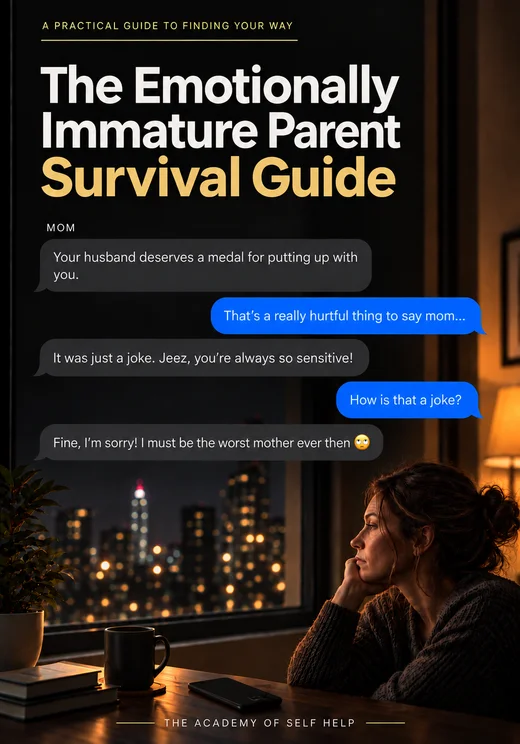
Knowing you're allowed to set a limit is one thing. Keeping yourself steady when the guilt arrives is another. The Emotionally Immature Parent Survival Guide offers practical help for protecting your energy, working through guilt, and planning contact on terms you can live with.